If you’re preparing for the TOPIK (Test of Proficiency in Korean), mastering the TOPIK 1 vocabulary is the first essential step toward building a strong Korean language foundation. The Korean TOPIK 1 vocabulary list introduces the most common and practical words used in everyday life, helping learners communicate effectively in basic situations. In this guide, you’ll discover everything you need to know about the TOPIK I vocabulary including study tips, learning strategies, and access to the Korean TOPIK level 1 vocabulary list PDF free download.

TOPIK 1 vocabulary
How Many Words Are in the TOPIK 1 Vocabulary List?
One of the first questions many learners ask when starting their TOPIK preparation is: “How many Korean words do I need to learn for TOPIK 1?”
It’s an important question because knowing the target word count helps you plan your study time and track progress effectively.
In general, the TOPIK 1 vocabulary list (which includes both Level 1 and Level 2 of the beginner stage) contains approximately 800 to 1,500 words, depending on the study guide or textbook you use. These are the fundamental Korean words that describe everyday life things you see, use, and talk about daily.
For example, the vocabulary covers basic topics like greetings, numbers, food, transportation, weather, school, and family. These words help you understand short conversations, simple descriptions, and basic written passages — exactly what appears in the TOPIK I exam.
Here’s a clearer breakdown of what to expect at each level:
|
TOPIK Level |
Focus Area |
Estimated Word Count |
Example Words |
|
TOPIK Level 1 |
Basic everyday expressions and communication (e.g., family, school, numbers, food, daily activities) |
800–1,000 words |
학교 (school), 친구 (friend), 집 (house), 물 (water), 사람 (person) |
|
TOPIK Level 2 |
Broader daily topics like travel, work, shopping, and weather |
1,200–1,500 words |
회사 (company), 시장 (market), 날씨 (weather), 영화 (movie), 기분 (mood) |
So, to pass the TOPIK I exam, it’s recommended that you aim to confidently understand and use at least 1,000 - 1,200 core Korean words. This range ensures that you can recognize most words in the listening and reading sections and even use them in simple written answers or conversations.
Note: These aren’t just random words. Every word in the Korean TOPIK 1 vocabulary list is chosen because it frequently appears in real-life communication and beginner-level Korean texts.
How many words for TOPIK 1
Effective Study Methods for TOPIK I Vocabulary
Learning the TOPIK 1 Korean vocabulary might seem like a big challenge at first, but with the right approach, you can turn it into an engaging, structured, and rewarding experience. The key to success is consistency, organization, and active usage. Instead of trying to memorize hundreds of random words, focus on methods that help you understand, remember, and apply vocabulary naturally in your reading, writing, listening, and speaking practice.
Below are some of the most effective techniques to help you master the Korean TOPIK 1 vocabulary list efficiently and confidently.
Study by Topic and Context
One of the best ways to study the TOPIK 1 vocabulary is to organize your learning by topic or theme. Rather than memorizing isolated words, focus on meaningful categories such as food, school, family, shopping, or transportation. This approach helps you understand how words are connected in real-life situations and strengthens long-term memory.
For example, if you’re studying the theme “Food and Eating”, you could learn 10–15 related words in one session:
- 음식 (food)
- 밥 (rice/meal)
- 식당 (restaurant)
- 메뉴 (menu)
- 주문하다 (to order)
- 맛있다 (delicious)
- 마시다 (to drink)
After memorizing these, create short sentences using each word:
- 저는 식당에서 밥을 먹어요. (I eat a meal at a restaurant.)
- 이 음식은 정말 맛있어요! (This food is really delicious!)
By connecting words through context, you’ll not only remember them longer but also gain the confidence to use them naturally in conversations and written exercises during the TOPIK I exam.
Pro tip: Create a weekly study schedule based on topics (e.g., Week 1: Family, Week 2: Food, Week 3: Transportation). This structured routine ensures you steadily cover all areas of the TOPIK beginner vocabulary list without feeling overwhelmed.
Use Flashcards and Spaced Repetition
Flashcards are one of the most effective and scientifically proven tools for memorizing the TOPIK Korean vocabulary for Topik 1 list. They use the principle of active recall, helping your brain strengthen memory connections each time you test yourself.
You can choose between physical flashcards or mobile applications such as Anki, Quizlet, or Migii, which offer pre-made TOPIK 1 vocabulary lists and interactive exercises.
When creating your flashcards, include:
- The Korean word (e.g., 친구)
- Romanization and English meaning (e.g., chingu – friend)
- A sample sentence (e.g., 저는 친구와 영화를 봐요. – I watch a movie with my friend.)
Using a spaced repetition system (SRS) ensures you review words just before you forget them, which is the best way to move vocabulary from short-term to long-term memory.
Study tip: Instead of reviewing hundreds of cards in one go, aim for 20–30 minutes of review every day. Daily repetition is far more effective than long, irregular study sessions. Over time, you’ll notice that even the most difficult Korean words start to feel familiar and natural.
Practice with Real Sentences and Situations
Memorizing the TOPIK 1 vocabulary list PDF is just the first step — the real goal is learning how to use those words correctly. To make vocabulary stick, you must apply it in real contexts.
Start by writing short paragraphs, diary entries, or even text messages using your newly learned words. For instance, after studying the theme “Daily Routines,” you can write sentences like:
- 아침에 일어나서 커피를 마셔요. (I wake up in the morning and drink coffee.)
- 회사에 가요. (I go to work.)
- 집에 돌아와서 텔레비전을 봐요. (I come home and watch TV.)
You can also read simple Korean stories or children’s books to see how TOPIK 1 words appear in natural sentences. Try highlighting new vocabulary and repeating the sentences aloud for better pronunciation and recall.
If you prefer listening practice, watch Korean YouTube channels or dramas with subtitles and note down the words you recognize from your TOPIK 1 vocabulary book. Hearing them used by native speakers helps you understand pronunciation, tone, and context — which are crucial for the listening section of the TOPIK test.
Consistency Is the Key to Success
Consistency is more important than intensity when it comes to learning the TOPIK Korean vocabulary list. Studying a small number of words every day produces far better results than cramming hundreds in one sitting.
Make it a habit to dedicate at least 20–30 minutes daily to reviewing your TOPIK 1 vocabulary list. You can do this while commuting, before bed, or during lunch breaks. Even short but focused sessions help your brain stay engaged and improve retention.
To maintain motivation, set mini-goals and track your progress. For example:
- Week 1: Learn 100 new words.
- Week 2: Review previous words and write 5 short sentences.
- Week 3: Take a mock test or quiz using only TOPIK 1 words.
Reward yourself after achieving each milestone a small celebration can keep your study journey positive and consistent.
Combine Reading, Listening, and Speaking
To get the most out of your TOPIK 1 vocabulary study, use a variety of learning methods that stimulate different skills. Read short articles or dialogues in Korean, listen to slow-paced podcasts or children’s shows, and speak aloud whenever possible.
The more you use Korean actively, the faster you’ll remember the vocabulary. Even if you make mistakes, don’t be discouraged. Every attempt helps you internalize new words and understand how they’re used in real communication.
Mastering the TOPIK 1 vocabulary takes time, but with consistent practice, smart tools, and contextual learning, you can make steady progress every day. Remember, the goal is not just to memorize words but to understand their meaning, pronunciation, and usage in daily Korean life. Once you feel confident with the TOPIK beginner vocabulary list, you’ll be well-prepared for the TOPIK I exam and ready to move forward to TOPIK 1 level 2 vocabulary and beyond.

Effective study methods for TOPIK I vocabulary
Download the Complete TOPIK 1 Vocabulary List PDF
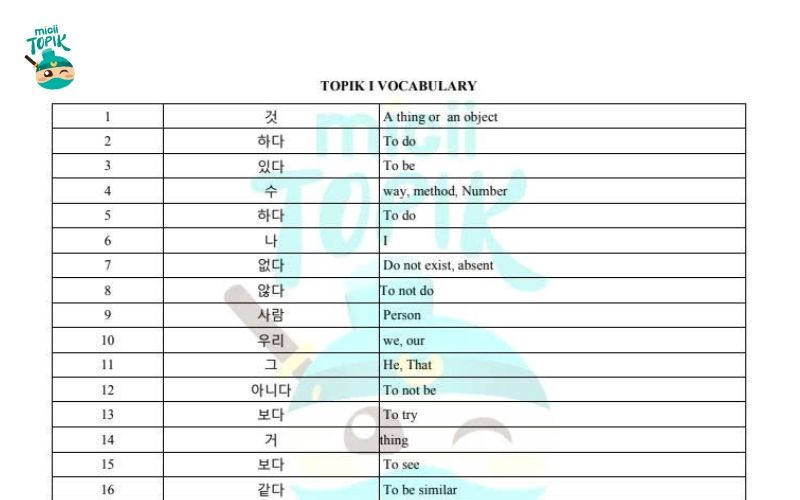
If you’re serious about preparing for the TOPIK I exam, having a well-organized vocabulary resource can make all the difference. Instead of collecting random words from different sources, you can streamline your learning with the TOPIK 1 Vocabulary PDF free download by Migii, a complete, beginner-friendly guide designed to help you master essential Korean words efficiently.
The Migii TOPIK 1 Vocabulary List PDF is more than just a simple word collection. It’s a comprehensive study companion that categorizes Korean vocabulary by topic, frequency, and practical usage, helping you learn smarter, not harder. Whether you’re just starting your Korean language journey or reviewing for the TOPIK 1 and 2 levels, this downloadable resource will keep your study sessions focused and productive.
Download the TOPIK 1 Vocabulary List PDF by Migii
You can download the complete TOPIK 1 Vocabulary List PDF by Migii for free and start building your foundation in Korean today.
Download the complete TOPIK 1 vocabulary List PDF
Learning TOPIK 1 Vocabulary with the Migii Platform
When starting your preparation for Topik 1 word list, having a clear and structured learning path is essential. The Migii platform provides not just vocabulary lists, but a complete learning experience from theory lessons to practical quizzes and test simulations. This system helps beginners learn TOPIK 1 vocabulary step by step, building a strong foundation instead of memorizing random words without context.
Korean Learning Materials on Migii
On Migii, learners have access to a full range of Korean study materials, including vocabulary, grammar, reading, listening, and mock tests for both TOPIK and EPS TOPIK. All lessons are categorized from level 1 to level 6, so you can easily choose the right level according to your current skills.
In the TOPIK 1 vocabulary section, each lesson includes essential beginner words with English and Vietnamese meanings, accompanied by simple example sentences for real-life use. After every lesson, learners can take a short multiple-choice quiz to review what they’ve learned and reinforce memory retention.
Because Migii’s structure follows the official TOPIK words list format, it helps learners study in an organized, exam-oriented way rather than trying to memorize disconnected words. You can explore the Korean learning materials on Migii today to start your journey toward mastering basic Korean vocabulary.
Vocabulary Theory and Practice for Level 1
The TOPIK 1 Vocabulary Theory section on Migii is concise, well-organized, and perfect for beginners. Each unit introduces key vocabulary lists along with clear definitions and example sentences that show how each word is used in everyday situations. After learning the theory, you can immediately test yourself through short quizzes designed to strengthen recall and track your progress.
This smooth combination of theory and practice allows learners to study and review TOPIK level 1 vocabulary PDF in one place, without needing extra tools or books. You can visit the Korean TOPIK Vocabulary Theory section on Migii to explore the lessons and start building your beginner word base effectively.
Practicing TOPIK and EPS TOPIK Level 1 Tests
Once you’ve completed the vocabulary lessons, Migii also offers practice tests that follow the real exam format. These include sections for listening, reading, and writing, helping you become familiar with how vocabulary appears in different question types.
Practicing with authentic-style TOPIK vocabulary list questions allows you to apply your vocabulary knowledge naturally and improve your test performance. By using these exercises regularly, learners can recognize familiar words faster and respond more confidently during the actual exam.
Start practising today in the TOPIK Test Practice section on Migii to assess your current ability and prepare effectively for your first Korean proficiency test.
Learning TOPIK 1 vocabulary with the Migii platform
Frequently Asked Questions
1. How many words do I need to pass TOPIK 1?
You’ll need around 800–1,500 words to pass the TOPIK I exam (Levels 1–2). Focus on practical vocabulary used in daily communication.
2. What’s the best way to study TOPIK 1 vocabulary?
Combine flashcards, spaced repetition, and writing practice. Study topics like “food” or “travel” to build connections between words.
3. Where can I find the official Korean TOPIK 1 vocabulary list PDF?
You can download it from reliable sources like Migii or educational resource drives such as the one linked above. These lists are categorized by level, making it easy to track your progress.
Conclusion
Mastering the TOPIK 1 vocabulary is your first big milestone on the journey to Korean fluency. With a strong foundation of beginner-level words, you’ll gain the confidence to communicate in everyday situations, understand Korean culture more deeply, and smoothly progress to higher TOPIK levels. Study consistently with Migii’s organized word lists, review tools, and practice examples, and apply what you learn every day. With Migii TOPIK by your side, you’ll be fully prepared to ace the TOPIK I exam and take your Korean to the next level.