EPS TOPIK registration is the first step for Vietnamese workers to take the Korean language test and be eligible to work in Korea under the EPS program. Candidates need to follow the announcement from HRD Korea, fill in all information and submit the application within the prescribed time limit. Performing EPS TOPIK registration correctly will help you avoid mistakes and ensure a smooth exam.
Introduction to EPS TOPIK
EPS TOPIK (Employment Permit System Test of Proficiency in Korean) is a Korean language proficiency test specifically for foreign workers who wish to work in Korea under the EPS – Employment Permit System program organized by the Korean Government and HRD Korea. Different from the regular TOPIK test for academic purposes, EPS TOPIK focuses on basic communication situations in work, daily life and workplace safety.
EPS TOPIK exam
The purpose of the EPS TOPIK test is to assess the Korean language ability of workers to ensure that they can understand and comply with instructions and regulations in the Korean working environment. This is an important screening step to select candidates with sufficient language ability, contributing to reducing communication barriers and improving labor efficiency.
Registering for the EPS TOPIK exam in accordance with the correct procedures and on time is of particular importance, because only candidates who have completed the valid registration procedures will be allowed to take the official exam. If the registration deadline is missed, workers will have to wait for the next exam, causing delays in their work plans in Korea. Therefore, mastering the EPS TOPIK registration process is the first and necessary step to get closer to the opportunity to work legally and stably in Korea.
Who Can Apply for the EPS TOPIK?
The EPS TOPIK (Employment Permit System Test of Proficiency in Korean) is open to foreign workers from countries that have signed a Memorandum of Understanding (MOU) with South Korea regarding labor dispatch — including Vietnam. This cooperation ensures that the recruitment and employment process is transparent, legal, and managed under the supervision of both governments.
- Age: Must be between 18 and 39 years old.
- Health: Must have good health, be free of disqualifying conditions like color blindness or color weakness, and not have infectious diseases like tuberculosis or hepatitis.
- Criminal record: Must have no criminal record of imprisonment or heavier punishment.
- Deportation: Must not have a record of deportation or departure orders from South Korea.
- Previous stay: Should not have stayed in South Korea for more than five years under an E-9 (non-professional employment) or E-10 (seafarer) visa.
- Other restrictions: Must not have any restrictions on leaving their home country and should not have an existing or active EPS application.
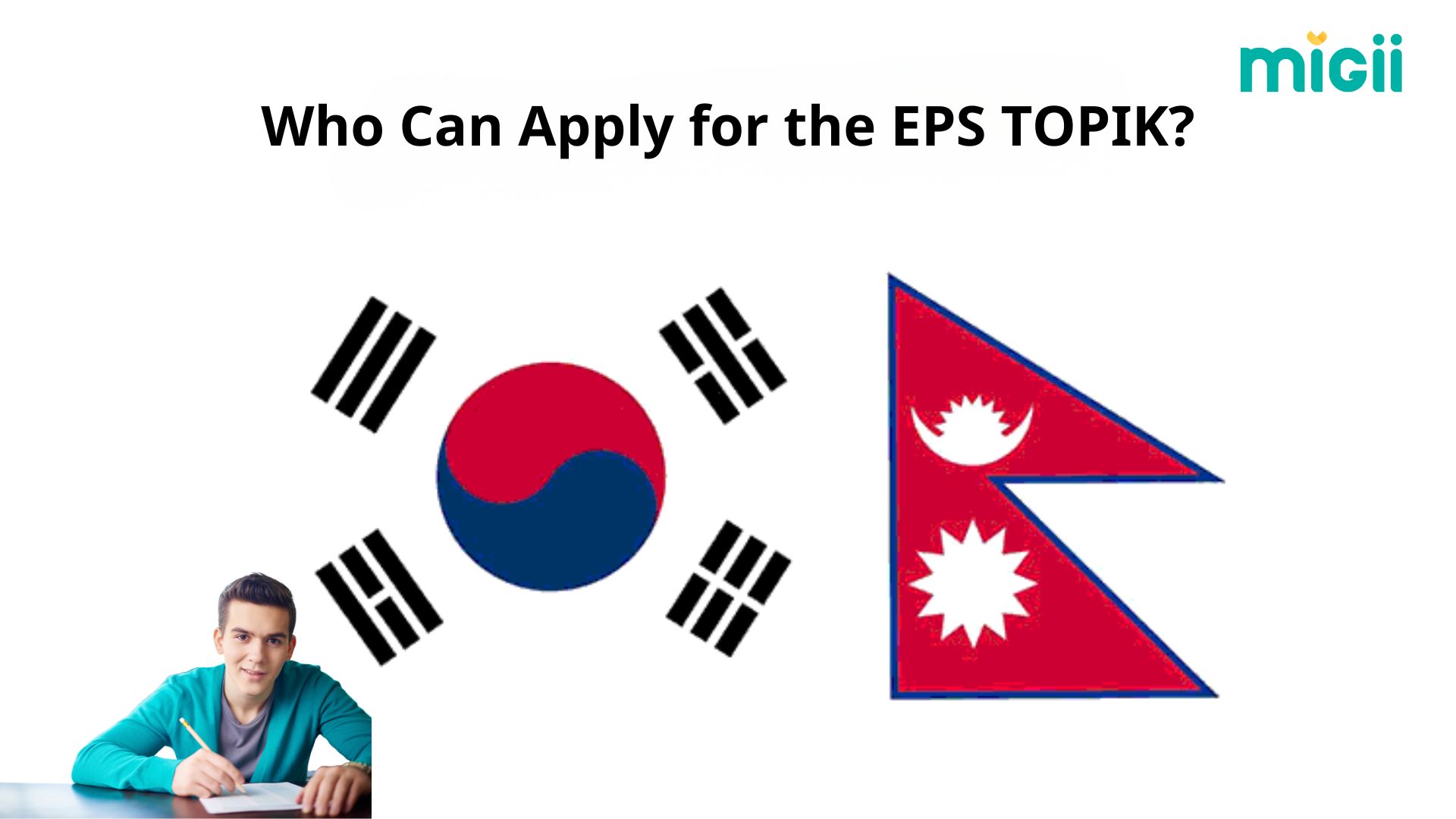
Who Can Apply for the EPS TOPIK
Furthermore, applicants must not fall under disqualified categories, such as having a criminal record, being restricted from leaving their home country, or having been deported from South Korea due to illegal stay or law violations. Meeting all these EPS TOPIK requirements is essential for eligibility to register and take the exam.
EPS TOPIK Registration Process (Step-by-Step Registration Guide)
The EPS-TOPIK registration process involves online registration on the official government website for your country, such as the Department of Migrant Workers (DMW) in the Philippines, followed by paying the exam fee and preparing for the test. Key steps include creating an account, filling out personal information accurately, selecting a test location and category, and uploading a valid ID and photo. You must complete the process and submit information before the deadline, as editing is not allowed after submission.
Step 1: Prepare your information
- Gather documents: Have a high-quality passport-sized photo (under 100KB) and a scanned image of your ID (passport, NID, etc.) ready. Ensure your ID image includes both front and back if necessary.
- Check eligibility: Confirm you meet the age and other requirements, such as having a passport with sufficient validity.
- Review details: Be sure to check the registration dates and have all information correct before starting, as there is no editing after submission.
Step 2: Register online
- Find the portal: Access the official EPS-TOPIK registration portal provided by your country's relevant agency (e.g., the DMW website or a link from their official Facebook page).
- Create an account: Register on the portal, usually by entering your email address and creating a password.
- Fill in personal data: Accurately enter all required personal information, such as your name, date of birth, and contact details.
- Select test details: Choose your preferred test location, a manufacturing category (e.g., Assembly, Measurement, Joining), and complete any other required fields.
Step 3: Submit and pay
- Review and submit: Double-check all the information you have entered. Once you submit, no further edits are possible.
- Make payment: Proceed to make the exam fee payment. You may need to install specific security modules if payment is delayed or fails.
- Confirm registration: After payment, confirm your registration status through the system's confirmation or management section.
Having a clear understanding of the EPS TOPIK registration process allows applicants to register accurately, avoid unnecessary delays, and successfully participate in the exam according to the official schedule.
Required Documents & Fees
When applying for the EPS TOPIK exam, candidates must carefully prepare all required documents and pay the registration fee according to official guidelines. Proper document preparation ensures a smooth registration process and prevents disqualification due to missing information. Below are the essential required documents and fees that applicants need to complete their EPS TOPIK registration.
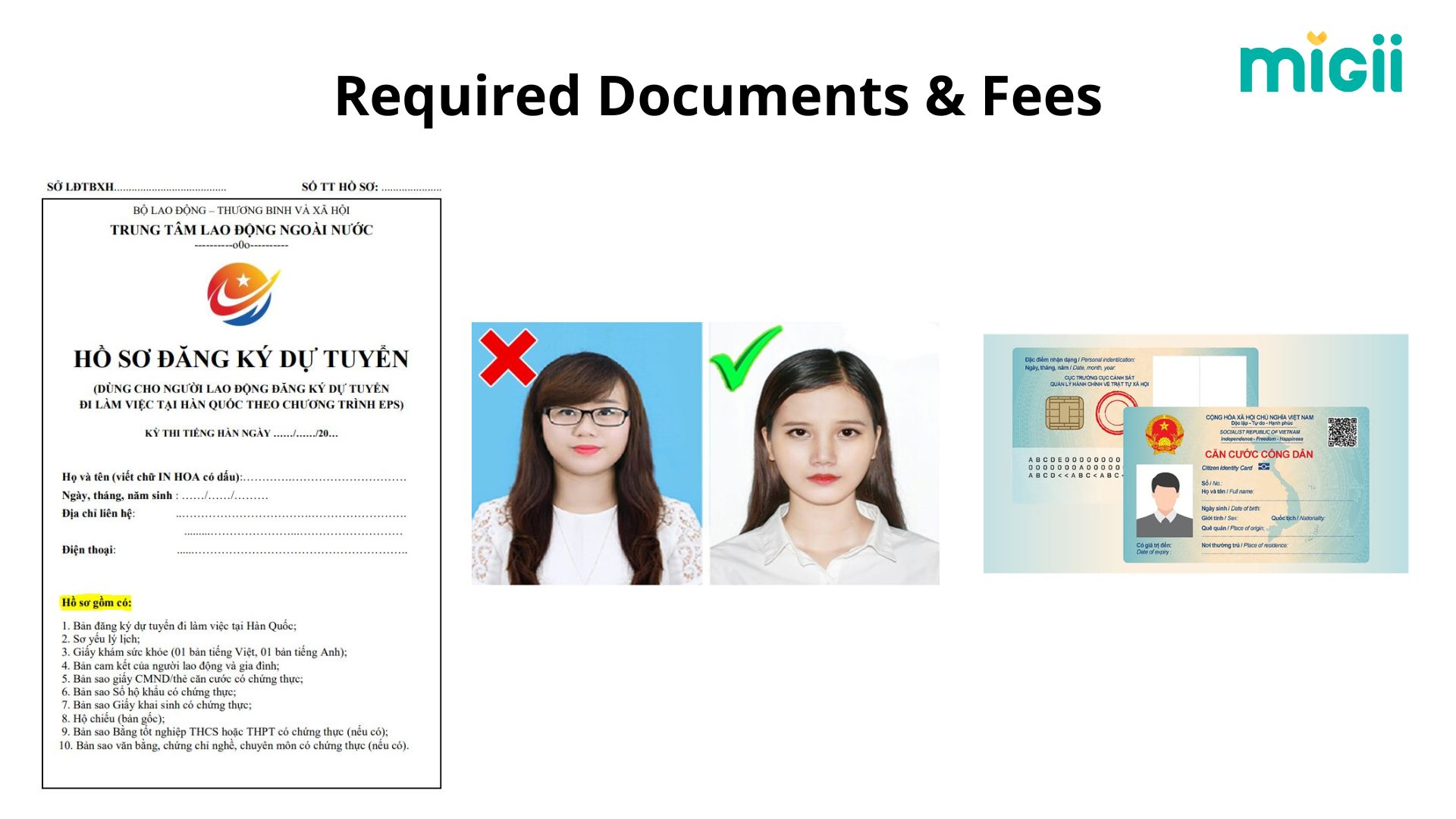
Required Documents & Fees
Required documents
Application form: Receive and fill in the information at the application reception location. Each candidate can only submit one application.
Identification documents:
- Photocopy of CCCD or passport
- You also need to bring the original CCCD or passport for verification when taking the exam.
card photo
- Quantity: 2 photos.
- Size: 3.5cm x 4.5cm.
- Time of taking: Within the last 3 months.
- Other requirements: White background, dark shirt. Full name, date of birth, and ID number must be clearly written on the back of the photo.
Registration Fee
Amount: The registration fee is approximately 28 USD per person, equivalent to around 700,000 VND based on the current exchange rate.
Payment: Applicants can make the payment in Vietnamese currency (VND) at the time of registration.
Refund Policy: In cases of force majeure where the applicant cannot take the exam, the registration fee will be refunded if the cancellation is made within the specified period. However, once the registration is canceled, the applicant will not be allowed to register for the exam again in that testing round.
EPS TOPIK and TOPIK 2025 Exam Schedule (Updated Information)
The EPS TOPIK 2025 exam registration period has already passed; however, the most recent TOPIK (Test of Proficiency in Korean) — the 102nd test session — was held from July 28 to August 4, 2025. To register for upcoming TOPIK tests, candidates should regularly check announcements on official websites such as IIG Vietnam or the TOPIK Korea portal. For the EPS TOPIK exam under the Employment Permit System (EPS) program, applicants must register online via www.colab.gov.vn, and detailed exam locations will be announced later by HRD Korea.
TOPIK 2025 Schedule (102nd Test Session)
- Hai Phong, Thai Nguyen, Phu Tho, Da Nang: July 28 – August 4, 2025
- Hanoi: July 29 – August 4, 2025
- Ho Chi Minh City, Lam Dong: July 30 – August 4, 2025
EPS TOPIK 2025 Schedule (Employment Permit Program)
- Registration period: March 31 – April 2, 2025
- Announcement of exam schedules and venues: April 14, 2025
- Round 1 Examination period (estimated): April 21 – June 27, 2025
- Round 2 Registration period: July 4 – July 10, 2025
Exam Locations
- TOPIK: Official test locations will be announced upon registration by the organizing institutions.
- EPS TOPIK: Test venues will be confirmed by HRD Korea after reviewing the number of applicants and local conditions. Candidates can register online through the Center for Overseas Labor’s website at www.colab.gov.vn.
Common EPS TOPIK Registration Errors and How to Correct Them
During EPS TOPIK registration, many candidates encounter common errors due to unfamiliarity with the process or oversight in preparing their application. A frequent mistake is incorrect personal information, particularly wrong passport numbers, full name, date of birth, or contact details. Such errors can lead to application rejection or invalid test results if not corrected.
Another common issue is late submission or missing required documents, such as ID card/passport, properly formatted exam photos, or the official application form. Candidates may also face problems with photos that do not meet specifications, including incorrect size, improper background, or outdated images. These mistakes can result in the application being rejected at the initial review stage.
To prevent and correct these errors, applicants should carefully review all information and documents before submission, ensuring that all papers are complete, valid, and that photos meet the official EPS requirements. If mistakes are discovered after submission, candidates should immediately contact the EPS center or the registration office for guidance on how to correct or update the information. Some corrections can be made online, while others may require submitting additional documents at the registration office according to official instructions.
Common EPS TOPIK Registration Errors and How to Correct Them
Being aware of common EPS TOPIK registration errors and how to address them helps candidates avoid the risk of rejection, ensures eligibility to take the exam, and guarantees that their results will be recognized. Proper preparation and adherence to the official process also save time and reduce stress during registration.
Tips for preparing for the EPS TOPIK exam
How to Study Effectively Before the Exam
First, build a clear study schedule: for instance, dedicate about 2–3 sessions per week, each 60–90 minutes, combining vocabulary study, listening practice, reading exercises, and mock tests. Set smaller goals according to the SMART framework (Specific – Measurable – Achievable – Relevant – Time‑bound) to monitor your progress.
In addition, using spaced repetition is crucial — rather than “cramming” everything at once, review material you learned a few days earlier to improve long‑term retention. Use short time slots (15–20 minutes) such as just before sleeping or while commuting to revise vocabulary or listen to short audio tracks.
Finally, don’t forget to practice according to the exam format — take mock tests under conditions similar to the real test: same timing, no interruptions, strict time management. This helps you become familiar with time pressure, refine your test strategy, and reduce stress on the actual test day.
Study Materials Review
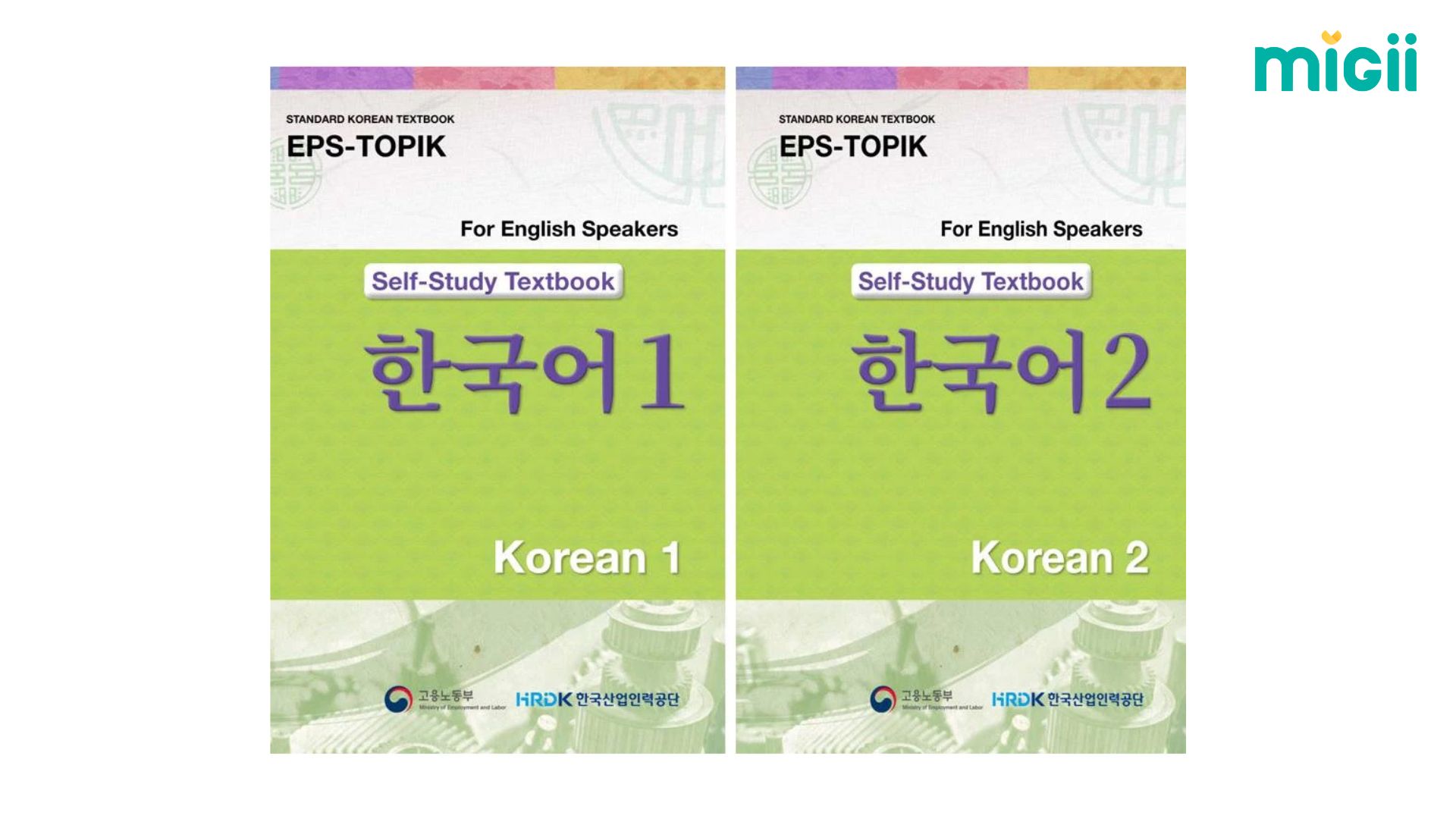
- Official Self‑Study Textbook (by HRD Korea)
The official EPS TOPIK self‑study book is a comprehensive resource designed to help candidates prepare effectively for the exam. It can be downloaded as an e‑book directly from HRD Korea’s website, making it easily accessible for self-study. The book is highly advantageous because it is official, covers all key sections including listening and reading, and provides structured exercises for thorough preparation.
To use it effectively, candidates should study each chapter carefully, complete the end-of-chapter exercises, and then review the material to reinforce their understanding and retention.
Official Self‑Study Textbook
Download link example: HRD Korea Self‑Study Text Book (e‑book section)
- Korean EPS TOPIK Book App
The “Korean EPS TOPIK Book 2025” app, available on Google Play, provides a convenient mobile platform for studying EPS TOPIK. It includes a variety of study materials, practice tests, and even an offline mode, allowing candidates to learn anytime and anywhere. The app is particularly useful because it is interactive, helping users improve their vocabulary, listening skills, and test-taking strategies. For optimal results, it is recommended to use the app during spare moments, such as while commuting, in combination with a physical textbook to reinforce and consolidate learning more effectively.
c) Vocabulary & Thematic Practice Materials
For your goal — studying specialized vocabulary for the EPS TOPIK exam — we recommend prioritizing the Vietnamese‑Korean bilingual EPS TOPIK textbook (the first book). If you want to expand and practice further, you can also use the Korean‑English version or additional supporting materials such as vocabulary PDF lists you have found. A combined approach works best: use the main textbook alongside a vocabulary app on your phone to study during spare moments.
Download link example: Vietnamese‑Korean bilingual EPS TOPIK textbook (the first book)
Tips for the Listening and Reading Sections
Listening section:
- Before the exam, practice listening at various speeds: slow, normal, fast to get accustomed to Korean spoken in labor environments or daily communication.
- On test day: before listening starts, quickly read the instructions, underline keywords in questions, and try to predict what you’ll hear. While listening — mark probably correct answers quickly, then eliminate clearly wrong choices.
- Pay close attention to “pauses” since these often give you a chance to preview the question — use that time to glance at the question and anticipate the answer.
Reading section:
- Use skimming (reading quickly to get the main idea) and then scanning (reading to find details). When scanning, look out for keywords like 날짜 (date), 장소 (place), 인원 (number of people) — questions often revolve around such details.
- If you encounter a difficult sentence or unfamiliar word: don’t get stuck too long — underline it and move on; finish easier questions first, then return to harder ones. This helps you optimize time.
- Notice text structure: introduction → body → conclusion. Questions often target the body (why, how, what) or conclusion (so, therefore). Recognizing this structure helps you anticipate correct answers.
Summary of Advice
- Build a clear study plan, allocate your time wisely, and steadily review.
- Combine official book, mobile app, and practice tests to learn vocabulary, listening and reading by theme.
- Practice mock tests under realistic conditions: correct timing, quiet environment, focus.
- During the exam: apply listening and reading strategies to manage time well, avoid leaving blanks, and eliminate incorrect answers quickly.
- Finally, stay relaxed, get enough sleep before exam day, and arrive early at the test venue to avoid unnecessary stress.
Conclusion
Understanding the EPS TOPIK registration process is crucial to ensure your application is valid and that you do not miss the opportunity to take the exam. Candidates should regularly check official sources such as HRD Korea and the EPS Center Vietnam – Ministry of Labor for the latest updates. Follow the exam schedule and register for EPS TOPIK today to get closer to the opportunity to work in South Korea! With Migii, you can effectively practice vocabulary and review, increasing your chances of achieving a high score on the exam.