Learn about EPS TOPIK — the mandatory Korean language test for anyone who wants to work in South Korea under the EPS program. This exam evaluates basic listening and reading skills to ensure workers can communicate safely in the workplace. Passing EPS TOPIK is the first and most important step before submitting your application to Korean employers. With proper preparation, this test becomes a clear pathway to stable jobs and higher income in Korea.
what is EPS
What is EPS?
EPS (Employment Permit System) is a legal employment program created by the South Korean government to recruit foreign workers in a transparent and controlled way. Managed by the Ministry of Employment and Labor (MOEL) and HRD Korea, this system ensures that both employers and workers follow strict regulations for safety, fairness, and proper labor management. Through EPS, Korea can effectively solve labor shortages in key industries such as manufacturing, agriculture, fisheries, and construction.
At the same time, the program opens valuable job opportunities for workers from other countries, offering stable income, legal protection, and a clear pathway to long-term employment in South Korea.
EPS TOPIK meaning
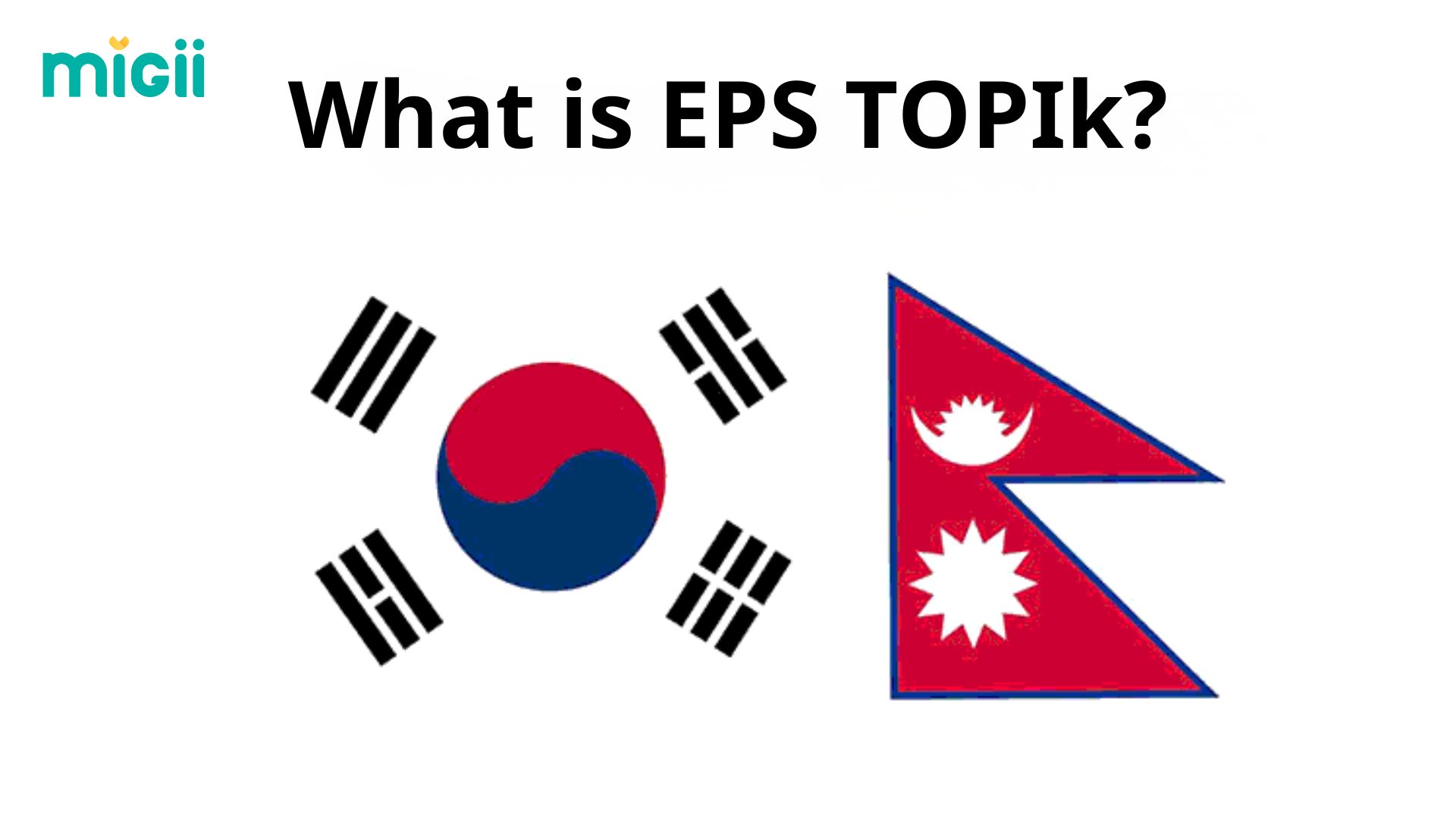
EPS-TOPIK (Employment Permit System – Test of Proficiency in Korean) is a mandatory Korean language test for foreign workers who want to work in South Korea under the EPS program. This program is managed by HRD Korea in cooperation with the Ministry of Employment and Labor (MOEL) of South Korea. It was designed to create a transparent and fair recruitment process while ensuring that workers understand and follow workplace regulations.
The main goal of EPS-TOPIK is to evaluate basic Korean language skills in a work environment. It helps foreign workers listen, understand, and follow instructions correctly, communicate effectively with supervisors and colleagues, and reduce the risk of accidents or misunderstandings at work. Passing this exam is a required first step before applying to Korean employers.
EPS-TOPIK only includes listening and reading sections. It does not test writing or speaking, as the purpose is to assess practical comprehension skills needed for real work situations. The content focuses on basic vocabulary and grammar, workplace dialogues, safety signs, and instructions commonly encountered in factories, farms, or production sites.
EPS topik
Successfully passing EPS-TOPIK provides several benefits. It is a prerequisite for submitting applications to Korean companies and increases the chance of being selected by employers. It also helps workers adapt more quickly to the Korean work environment and culture. Additionally, it provides a foundation for further language learning, supporting long-term career opportunities in South Korea.
EPS-TOPIK is especially relevant for Vietnamese workers aiming to work in manufacturing, agriculture, fisheries, or construction. It ensures that applicants meet basic language requirements and are prepared to work safely and effectively in Korea. Preparing for listening and reading, as well as learning essential vocabulary and grammar, is crucial for success in the EPS program.
Who needs to take the EPS-TOPIK test?
Vietnamese workers who want to export labor to Korea under the Employment Permit System (EPS) need to take the EPS-TOPIK certificate. This certificate is a mandatory condition to be able to register for jobs, especially in the field of unskilled labor.
Specific subjects need to take EPS-TOPIK:
- Workers who wish to work in Korea under the EPS program.
- This program includes unskilled workers (E-9) and some similar programs.
- If you have worked in Korea under the EPS program, you are only allowed to re-enter if you have returned to your home country within the contract period.
Who needs to take the EPS-TOPIK test
The EPS-TOPIK test is required for foreign workers who want to work in South Korea under the Employment Permit System (EPS). It is specifically for those seeking jobs in industries such as manufacturing, agriculture, fisheries, and construction. Applicants must meet certain conditions, including age, health, and legal background requirements, to be eligible to take the test. Essentially, anyone planning to work legally in South Korea through the EPS program needs to pass this exam.
Benefits of having EPS-TOPIK certificate
1. Job Opportunities in South Korea
Having the EPS-TOPIK certificate is a mandatory requirement to participate in the EPS labor program in South Korea. It is the first and most important step for Vietnamese workers to submit applications and be selected by Korean companies. EPS-TOPIK is not just a language test; it is a standard for employers to assess basic communication skills and the ability to adapt to the workplace.
Benefits of having EPS-TOPIK certificate
A good EPS-TOPIK result also enhances competitiveness in the job market. Applicants with this certificate stand out, attracting the attention of Korean employers, which increases their chances of being selected and signing a work contract. The certificate demonstrates that the worker has the basic skills to work safely and effectively.
Moreover, working in South Korea under the EPS program offers attractive salaries compared to many jobs in Vietnam. With stable monthly incomes ranging from 32 to 45 million VND depending on the industry and position, workers can improve their quality of life, gain valuable experience, and build a solid foundation for long-term career development.
2. Personal Development
Preparing for EPS-TOPIK helps enhance overall Korean language skills. Workers not only improve listening and reading abilities but also gain basic communication skills necessary for work and daily life. This builds confidence in interacting with colleagues and supervisors and understanding workplace instructions in Korea.
The learning process also expands understanding of Korean culture. During preparation, learners are exposed to customs, lifestyle, and work culture in Korea, making it easier to adapt to a new living and working environment. Cultural understanding reduces confusion and improves communication skills in an international setting.
Additionally, studying for EPS-TOPIK develops discipline and perseverance. Learning vocabulary and practicing listening and reading require consistent daily effort. Learners cultivate a proactive attitude, time management skills, and self-learning abilities – essential qualities for both work and life.
3. Opening Up More Opportunities
EPS-TOPIK results not only serve the purpose of working in Korea but also open many other opportunities. Learners can use the certificate to apply for scholarships to study in Korea, expanding educational and career paths.
Furthermore, strong Korean language skills provide opportunities to work in international environments, such as Korean companies in Vietnam or multinational companies linked to Korea. This allows workers to increase their income while gaining valuable professional and international work experience.
EPS TOPIK test structure
Exam format eps topik
The EPS-TOPIK test is designed to evaluate the basic Korean language skills required for working in South Korea under the EPS program. The exam is entirely multiple-choice, focusing on practical comprehension in workplace contexts. It consists of two main sections: Listening and Reading, each containing 20 questions. The total score for the exam is 200 points, and the total time allowed is 50 minutes, with 25 minutes allocated for the listening section and 25 minutes for the reading section. This format ensures that applicants are tested on essential skills without the stress of writing or speaking components.
|
Section |
Number of Questions |
Time |
Score |
|
Listening |
20 |
25 min |
100 |
|
Reading |
20 |
25 min |
100 |
|
Total |
40 |
50 min |
200 |
Overall, understanding the structure of the EPS-TOPIK test is crucial for effective preparation. Familiarity with the number of questions, timing, and scoring allows applicants to manage their time efficiently and focus on the areas that matter most. Proper preparation using practice tests and relevant study materials can greatly improve performance and increase the chances of successfully passing the exam, which is an essential step toward working legally and safely in South Korea.
Details of each part of the eps topik exam
The EPS TOPIK exam has two main sections: Listening and Reading, each with 20 questions, totaling 40 questions and a total score of 200 points. The test takes 50 minutes to complete, with 25 minutes allocated for each section. The Listening section assesses comprehension of spoken Korean, including dialogues, announcements, and workplace conversations, using materials like photos and pictures. The Reading section evaluates understanding of written Korean, covering vocabulary, grammar, practical information, and comprehension of texts.
Listening Section
- Number of Questions: 20
- Time: 25 minutes
- Total Score: 100 points
- Content: Tests the ability to understand spoken Korean.
- Question Types: Includes understanding sound marks, visual materials (photos and pictures), and dialogues or stories (including occupational safety).
Reading Section
- Number of Questions: 20
- Time: 25 minutes
- Total Score: 100 points
- Content: Tests the ability to understand written Korean.
- Question Types: Covers vocabulary, grammar, practical information (like data and signs), and comprehension of passages.
EPS Exam Process – From Registration to Departure
Check the eligibility
To be eligible for the EPS-TOPIK, you must meet the age requirements (18-39), have no criminal record, have never worked in Korea under the EPS program (or have returned to your home country on time), and have no relatives residing illegally in Korea. You must also be in good health, not be colorblind, and have adequate vision.
Personal Requirements
- Age: Between 18 and 39 years old.
- Criminal Record: No criminal convictions, criminal history, or legal restrictions, and not prohibited from leaving Vietnam.
- Residency in South Korea: Must not have stayed illegally in South Korea (under E9 or E10 visas) for more than 5 years. Those who have previously worked in South Korea under the EPS program must have returned to Vietnam upon completion of their contract.
- Relatives in South Korea: Must not have any relatives (father, mother, children, siblings, spouse) residing illegally in South Korea.
Health and Vision Requirements
- Health: Must be physically fit and meet the health standards required for working abroad, according to the Ministry of Health regulations.
- Vision: Must not have color blindness or other color vision disorders.
Register for the language exam
To take the EPS-TOPIK exam, applicants must follow the official registration procedure. First, candidates need to register online through official channels, including the HRD Korea website or the Department of Labor, War Invalids, and Social Affairs (LĐTBXH) in Vietnam. Online registration ensures that personal information and application data are managed transparently and prevents fraudulent or invalid registrations.
After registration, candidates are required to pay the examination fee as stipulated. This fee is mandatory and helps cover the cost of organizing the exam, ensuring the quality of the test and facilities for candidates.
Once registration and payment are completed, candidates will receive an Exam Admission Ticket. This document contains personal information, test location, date and time, and important instructions. Candidates must print and bring the ticket on the exam day to be allowed entry. The ticket also allows candidates to verify their personal information and avoid any errors or missing details during the examination.
Submit application
After completing the EPS-TOPIK exam and achieving a qualifying score, applicants proceed to submit their application forms. The application includes the official registration form along with all required documents as instructed by the managing authorities. Submitting the application ensures that personal information, qualifications, and exam results are sent accurately to Korean employers.
Once the application is received, the managing authority forwards it to South Korea for employers to select suitable candidates. This process allows companies to review applications based on their recruitment needs, EPS-TOPIK results, and other criteria such as experience, professional qualifications, or specific skills. This step is crucial in determining the applicant’s chances of securing a contract and working legally in South Korea.
English Version
The selection process in South Korea depends on the applicant’s industry. For the fisheries sector, candidates usually undergo a direct or online interview so that employers can assess their practical skills and experience. For other industries, selection is primarily based on the application form and EPS-TOPIK results, allowing companies to choose suitable candidates quickly and transparently.
After passing the evaluation, workers will sign an official employment contract with the Korean employer. The contract specifies job responsibilities, duration, salary, rights, and obligations, ensuring legal protection for both parties.
Before departing for South Korea, workers are required to participate in a 45-hour training course organized by the managing authority. This training provides knowledge about Korean culture, labor laws, workplace safety, survival skills, and basic Korean communication, helping workers adapt quickly to the new working environment.
Once the training is completed, workers will depart according to the schedule provided by the EPS program. The departure schedule is organized to ensure a smooth, safe, and lawful transition between Vietnam and South Korea.
Korean content to learn for EPS-TOPIK exam
Vocabulary Topics
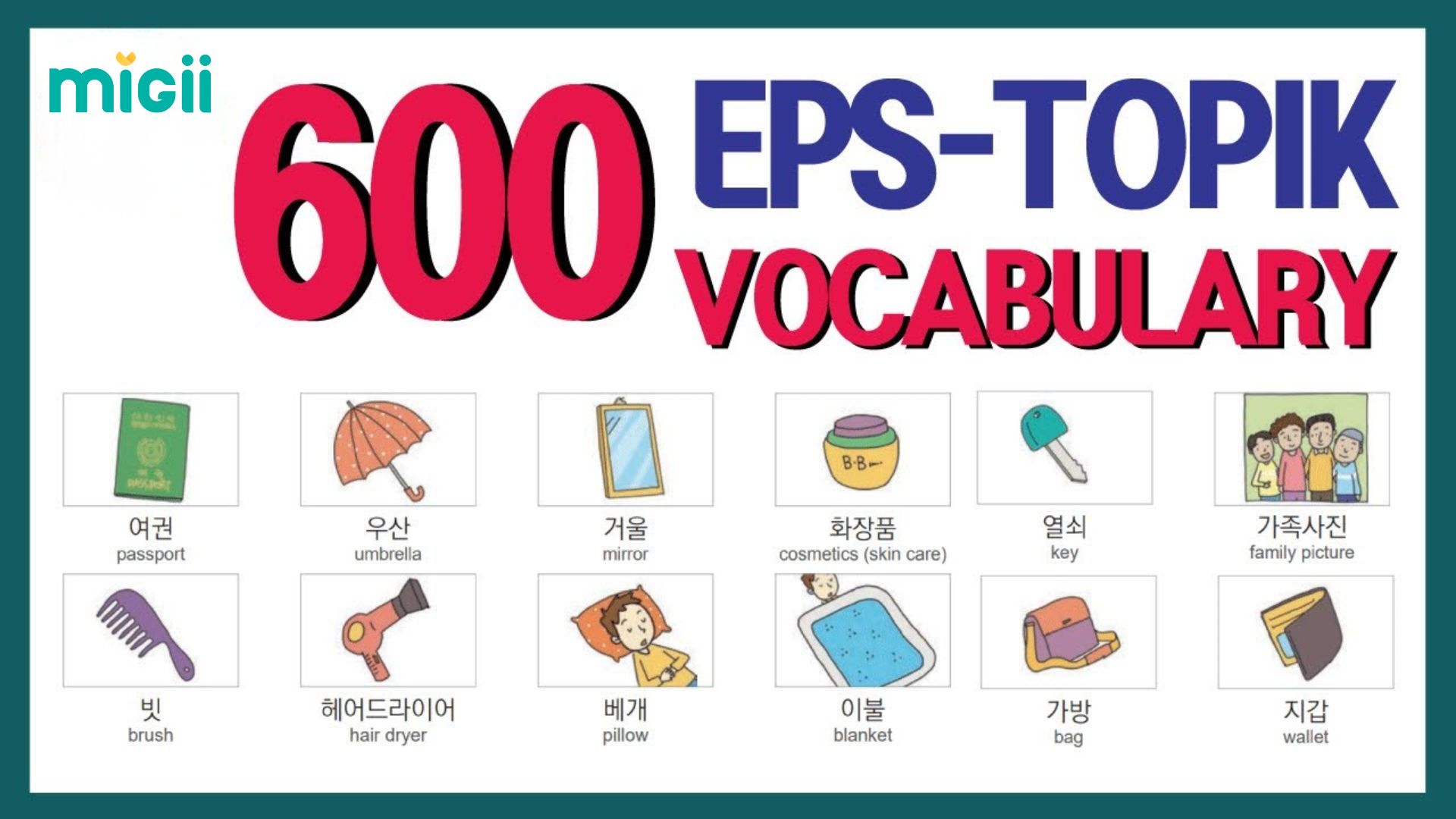
To succeed in the EPS-TOPIK exam, candidates should focus on vocabulary related to practical workplace situations. Key topics include:
- Work and Tools: Terms used in daily labor, machinery, and tools.
- Factories and Workshops: Vocabulary to understand factory operations, production processes, and work environment.
- Workplace Safety: Words and phrases related to safety instructions, personal protective equipment, and emergency procedures.
- Time, Numbers, and Units: Days, months, hours, units of measurement, and counting objects.
- Health and Illness: Basic medical terms, symptoms, and health-related vocabulary to communicate with supervisors or in emergencies.
- Basic Communication: Common expressions for greetings, requests, and instructions at the workplace.
- Korean Signboards: Vocabulary and symbols often seen on workplace signs, hazard warnings, and instruction boards.
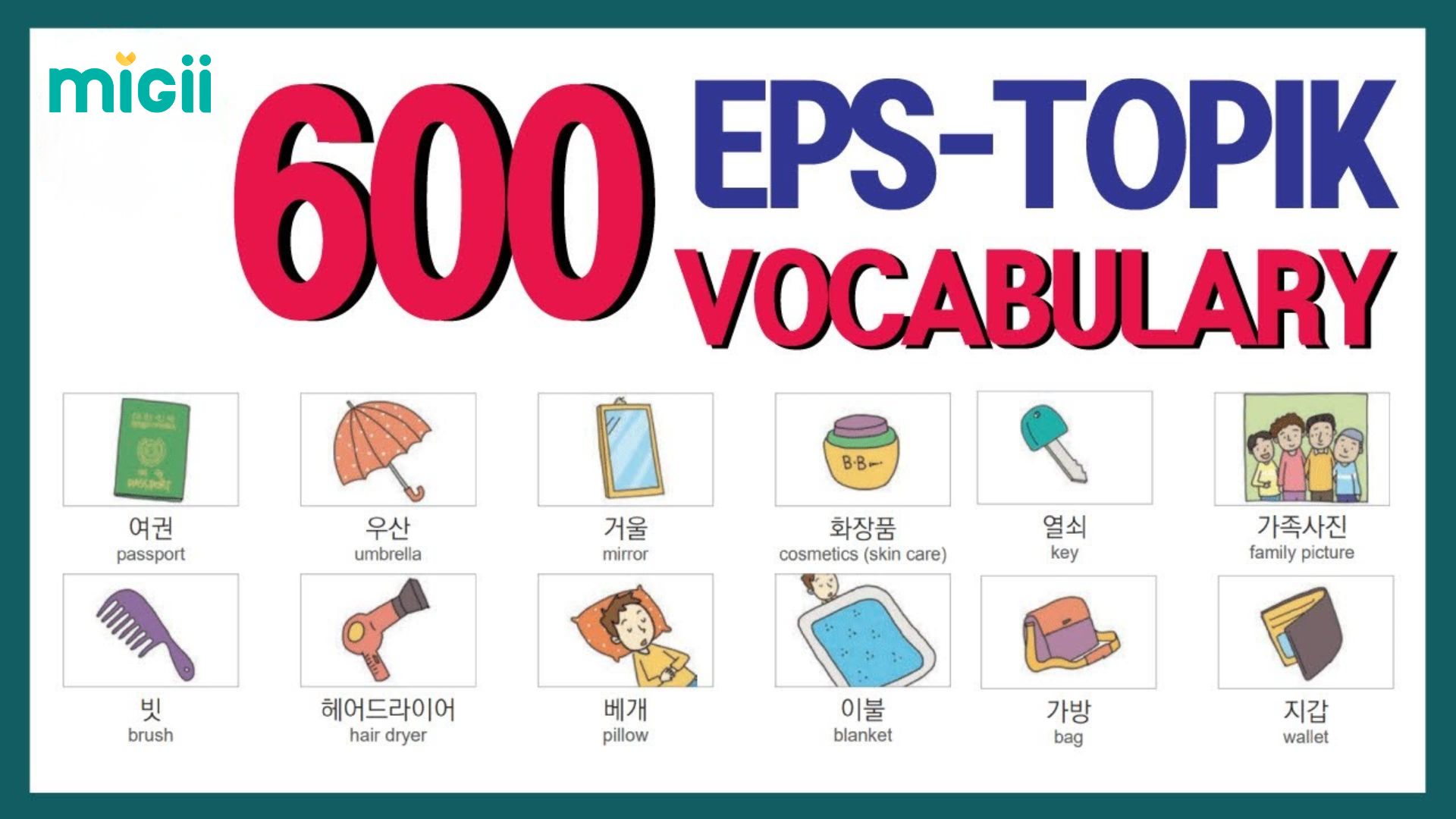
Vocabulary Topics eps topik
Focusing on these topics helps candidates understand listening and reading materials in the EPS-TOPIK exam, which are based on real-life situations in factories, farms, and other workplaces.
Download the list of Topics in 30 days here:
Grammar
EPS-TOPIK tests basic grammar from beginner levels 1–2 (A1–A2). Candidates should learn frequently used sentence structures to improve comprehension:
- -아요/어요: Polite present tense endings
- -(으)세요: Polite imperative / request
- -고 싶어요: Expressing desire (“I want to…”)
- -아/어서: Connecting sentences to show reason or sequence
- -(으)로: Direction, means, or method
- -지만: Contrast (“but”)
- -(으)려고 하다: Expressing intention (“intend to…”)
Mastering these structures is essential for understanding exam questions and workplace instructions.
EPS TOPIK test preparation tips – extremely important
Listening Tips
- Look at the answer choices before the audio plays: This helps you anticipate what to listen for and focus on keywords.
- Underline keywords in pictures or questions: Highlight important words that indicate the main idea or specific details.
- If the audio is unclear, choose the longer answer: Statistically, longer options are often correct in EPS-TOPIK listening questions.
- Practice listening at normal speed without slowing down: Training at real exam speed improves comprehension under time pressure.
- Review images related to factories, agriculture, and safety: Many listening questions are based on workplace scenarios.
Reading Tips
- Do the easier questions first: Fill-in-the-blank or picture selection questions can be solved quickly and save time.
- Do not translate everything: Focus on keywords to understand the meaning rather than translating every word.
- Guess the meaning of unknown words using context: Context clues are often sufficient to select the correct answer.
- When stuck, eliminate clearly wrong answers: Narrowing down options increases the chance of choosing the right answer.
Effective EPS-TOPIK preparation requires strategic listening and reading techniques. Candidates should practice recognizing keywords, using context clues, and managing time wisely. Focusing on workplace-related vocabulary, safety instructions, and common grammar structures will significantly improve performance. Consistent practice with real-speed audio and sample reading exercises is key to achieving a high score.
Tips for high score candidates
To achieve a high score in the EPS-TOPIK exam, practicing past exams from the last 3–5 years is extremely important. Working with real past tests helps candidates become familiar with the exam structure, question types, vocabulary, and listening/reading speed, while also improving time management during the test. This practice allows candidates to identify common mistakes and enhance their skills in each type of question.
In addition to practicing past exams, studying HRD Korea’s standard EPS vocabulary is essential. Around 1,500 basic words focusing on topics such as work, factories, workplace safety, basic communication, time, numbers and units, health, and signboards form the foundation for understanding reading and listening questions. Consistently learning and applying these words in practice exercises increases the chances of achieving a high score.
Moreover, candidates should practice full mock exams under real-time conditions: 25 minutes for listening and 25 minutes for reading. Simulating exam conditions helps candidates get used to time pressure, improve listening response speed, and develop fast reading skills to select correct answers. This method allows learners to self-assess and effectively improve their scores before the official test.
EPS TOPIK study materials
Books EPS-TOPIK Preparation
1. Beginner EPS-TOPIK (HRD Korea) – Original Version
This is the official textbook from HRD Korea, including vocabulary, grammar, listening, and reading exercises designed according to the EPS-TOPIK exam. Advantages: content closely matches real exam scenarios with clear examples. Disadvantage: entirely in Korean, so beginners may need prior knowledge or teacher guidance.
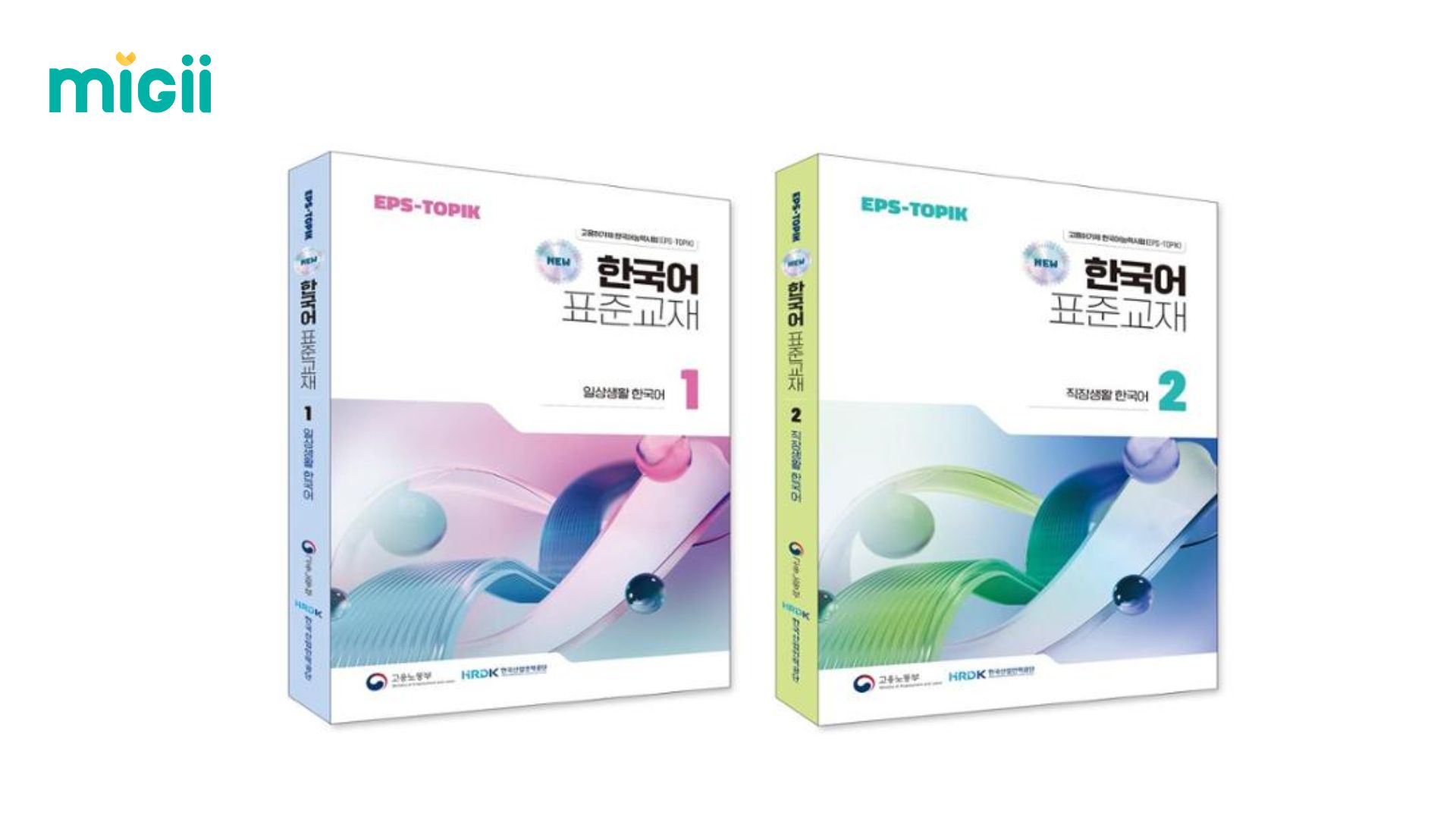
2. EPS-TOPIK Textbook for Vietnamese Workers
This textbook is tailored for Vietnamese learners, with vocabulary and grammar explained in Vietnamese and practical examples from Korean workplaces. It’s suitable for learners who want structured lessons with easy understanding. Disadvantage: content may not be as complete as the original, and some advanced structures appear less frequently.
EPS-TOPIK Textbook for Vietnamese Workers
3. Hackers EPS-TOPIK (Listening + Reading)
A popular practice book focusing on listening and reading skills. It provides many exercises simulating real exam formats, helping learners practice speed, keyword recognition, and exam strategies. Disadvantage: explanations are not in Vietnamese, so careful self-study is needed.
4. EPS-TOPIK All New (2024 Edition)
This latest edition updates all new question types, including listening, reading, vocabulary, grammar, and exam strategies. It’s ideal for final exam preparation and getting used to the latest exam trends. Disadvantage: higher cost and the updated content may be overwhelming for beginners.
Eps Topik test app
You should use a dedicated application to practice for the EPS‑TOPIK exam because this helps you practice anytime, anywhere, easily improve your listening and reading skills and get used to the exam format. For example, the “EPS TOPIK Exam Practice” application on Android provides many simulated questions that closely match the actual structure of the exam: 40 questions (20 listening + 20 reading), 50 minutes, friendly interface and detailed explanations.
Another option is “EPS TOPIK | UBT - Learn Korean”, which is specifically designed for workers who want to go to Korea under the EPS program. This application has exercises based on the EPS‑TOPIK model, updates new questions weekly, and supports offline learning mode.
If you have an iPhone or iPad, you can download the “EPS TOPIK App” from the App Store – it also provides listening and reading practice, vocabulary lists, and grammar lessons geared towards the EPS‑TOPIK exam.
Conclusion
EPS‑TOPIK is a critical step to open the door to working in South Korea, determining your chances of being selected and adapting to the workplace. Learners should focus on vocabulary, listening, and reading skills, and practice in the correct exam format to get used to time pressure and question types. Using high-quality materials, official textbooks, practice sets, and test apps such as Migii can significantly improve learning efficiency, enhance skills, and increase the likelihood of achieving a high score in the EPS‑TOPIK exam.